



Engineers, Biologists Capture the Aerodynamic Secret Behind a Hawk's Mid-Flight Transformation
When a Harris’s hawk is gliding through the air and encounters a narrow gap, it tucks its wings and hurtles its body through the opening, an aerodynamic feat modern aircraft could only dream of mimicking.
In new research from the University of California, Davis, and the University of Oxford, the acrobatic marvel is documented in live birds for the first time, revealing that the bird morphs from an unstable, maneuverable configuration into a stable, controlled one mid-flight.
The knowledge of how hawks morph mid-flight, published in the Journal of the Royal Society Interface, could transform how engineers design uncrewed aerial vehicles, or UAVs, that can adapt to various environments, and it would not have been possible without the combination of technologies and resources of these two intercontinental universities, as well as biology and engineering, two unlikely disciplines, working together.
For Huanglun “Adam” Zhu, a Ph.D. student in mechanical and aerospace engineering and co-author of the paper, the interdisciplinary, international collaboration was formative and life-changing.
“It’s definitely an unforgettable experience collaborating with people outside the university,” Zhu said. “As an engineer, you want to hear different people’s perspectives, what they’re pursuing and how something can be solved from their end. This type of cross-discipline collaboration is really so valuable.”
Capturing Birds in Motion

The flight stability of bird wings had been studied before. Christina Harvey, now an assistant professor of mechanical and aerospace engineering at UC Davis, had imaged the wings of bird cadavers in different shapes and used those scans in wind-tunnel experiments to show that birds could shift between stable and unstable flight. But whether a living bird actually made that shift, and when, remained unknown.
“Our project was the first one to combine live bird motion capture with wind tunnel experiments to ask, ‘Does the bird actually shift its stability characteristics in flight?’” said Zhu, who was an undergraduate student researcher in Harvey’s lab when he began this project.
To do this, they needed two things: access to birds and motion capture technology. This is where Oxford came in.
Kiran Weston was pursuing his Master of Biology at Oxford under Graham Keith Taylor, a professor of mathematical biology at Oxford whose research focuses on animal flight. For his final research project, Weston wanted to understand hawk flight stability and how it might be applied to UAVs.
“I wanted to do something that was inherently quite practical and had an outcome at the end of it,” Weston said. “This work allowed us to investigate the engineering components and the aerodynamics, and practically and physically evaluate models that were based on biologically relevant shapes.”
Luckily, on Oxford’s property, there is a building outfitted with a motion capture system that tracks trained Harris’s hawks and other birds as they fly around the facility. The technology is essentially the same as that used for Hollywood special effects, where tiny trackers record an actor’s movements to animate a digital model.
Cameras tracked small, reflective markers affixed to the hawk’s feathers and tail as the bird soared through the air, wings outstretched, then tucked to pass through a narrow gap that ranged from 37 to 70 centimeters wide.
The markers were then converted into points and coordinates in a 3D digital space. Weston used that data, along with avian airfoil measurements from previous studies, to reconstruct the bird’s flight path and generate five wing and tail configurations adopted across the maneuver.
“It was an incredible experience to get these sorts of insights that had never really been possible before from birds,” he said.
From Data Points to 3D Wings
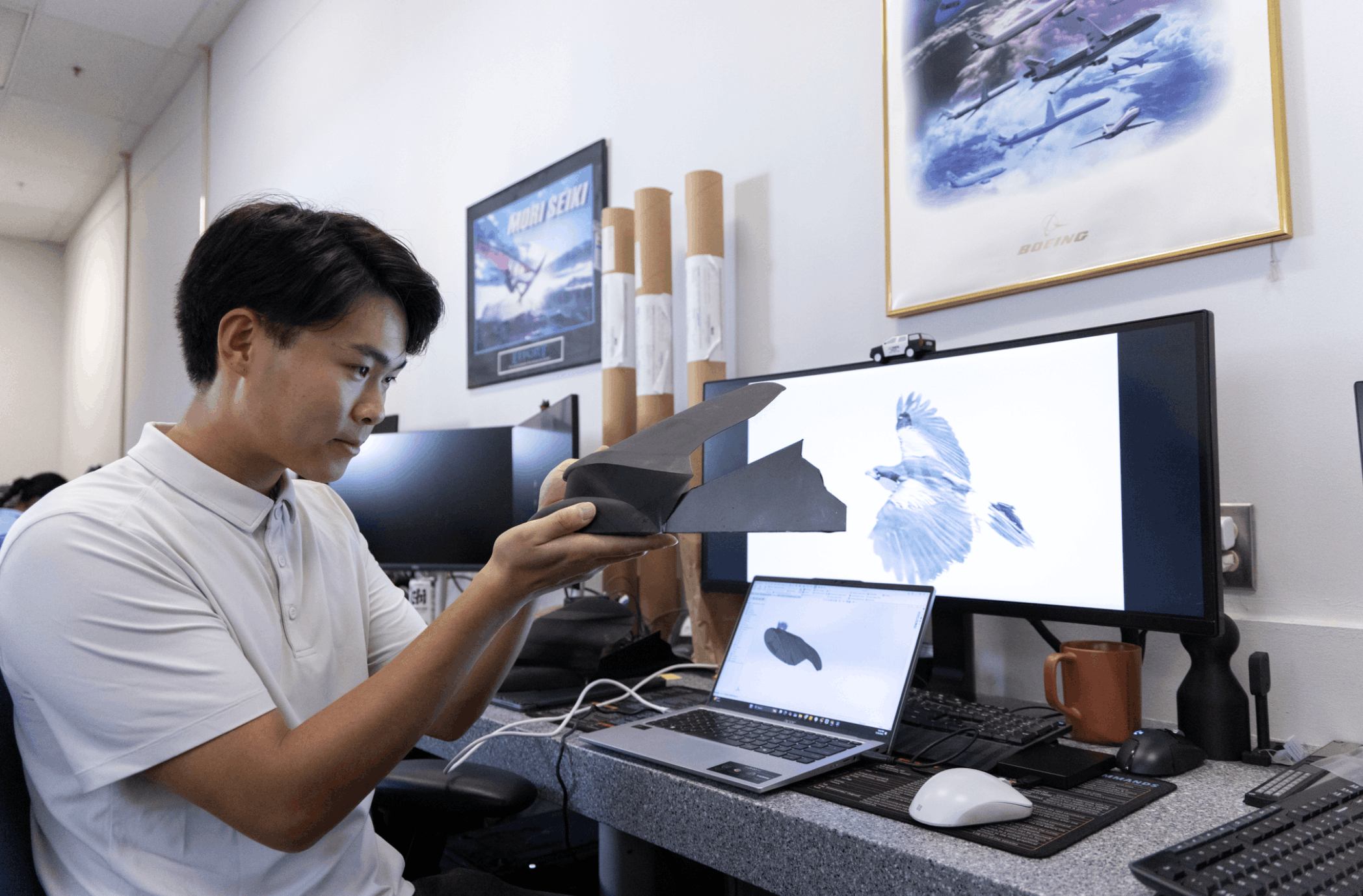
The points and initial models were later sent to Harvey’s lab, where her student Zhu refined the wing geometries, incorporated a standardized body section and prepared the models for fabrication and wind tunnel testing at UC Davis.
Zhu then worked with the UC Davis Diane Bryant Engineering Student Design Center, or ESDC, to 3D print the configurations utilizing rigid resin rather than the more commonly used FDM. 3D printing with resin can be more complex and time-consuming because it uses UV light to harden liquid resin into solid layers, and it requires a post-printing alcohol rub and UV curing.
However, Zhu said they chose resin for a few reasons.
The resin printer could handle the highly detailed, complex geometry of the wing models — hawk wings are curved, twisted along the wingspan and very thin at the trailing edges — and provide a smooth surface finish better suited for wind-tunnel testing than FDM printing. It could also print the large volume Zhu needed. (Actually, Zhu wanted a full-size replica but settled for 73% scale due to the wind tunnel’s dimensions.)
“Printing with resin is definitely more work compared to FDM, but you have higher resolution and high accuracies, so it was worth it,” Zhu said. “When I saw the first wing come up out of the printer, it was exciting.”
Into the Wind Tunnel

Weston joined Zhu at UC Davis for the wind-tunnel experiments in the fall of 2023. Zhu mounted the wing models vertically in the UC Davis Aeronautical Wind Tunnel, a low-speed wind tunnel ideal for studying small aircraft and birds. The wing models sat above a six-axis load cell that converts mechanical forces such as torque or tension into an output signal. An acrylic boundary-layer plate isolated the airflow around the wing from turbulence caused by the mounting hardware.
The researchers tested 41 angles of attack per model, physically adjusting the angle by 1 degree and collecting data for 10 seconds before moving to the next angle.
The data allowed them to determine whether the model was aerodynamically stable, meaning its ability to return to its original flight path after being disturbed by a gusty wind. In a hawk’s most extended configuration with wings fully stretched out, it was statically unstable (i.e., it moved away from its position). In its most tucked configuration, with its wings tight to its body, it was statically stable (i.e., it maintained its position). This means that birds shift stability in this extreme tucking maneuver.
“The real standout of this work is that it was the first work to show off the stability of live birds while they're flying and interpret why that's being used in the context of a specific maneuver,” Weston said.
A New Nest for Research
With the recent opening of the Center for Animal Location and Innovation, or CALI, led by Harvey in collaboration with the California Raptor Center at the School of Veterinary Medicine, this type of end-to-end research can now be done completely at UC Davis. CALI is equipped with state-of-the-art motion capture and high-speed cameras with photogrammetry technologies to image birds of prey during complex maneuvers and convert those maneuvers into data points that can be used to construct 3D models for printing and use in experiments.
CALI’s equipment, paired with the access to live birds of prey, plus the manufacturing and testing capabilities of the ESDC and the Aeronautic Wind Tunnel, respectively, creates an unrivaled research ecosystem. One that Zhu feels UC Davis is uniquely positioned to provide.
“There are only a couple of labs in the world, as far as I know, that can do motion capture on live birds, and here then we also have the in-house capabilities to carry that work forward through 3D reconstruction, manufacturing and wind tunnel testing,” he said. “Not all universities have wind tunnels with such a large testing section. Ours is also a low-speed wind tunnel, which is well-suited for studying bird flight. UC Davis is a really good place to blend all of it together.”